

Efficiency meets precision
Renowned clients trust in our products.







What our customers say
– Plant manufacturer, NRW
– Managing Director, Control Technology
– Plant manufacturer, NRW
– Project manager, plant design
Time is money – we deliver reliably and on time. Express shipping or courier service is also available upon request.
No call center, but
real experts who answer your questions.
From product selection to commissioning and problem solving, we are at your side.
Whether training courses, service assignments, or customized solutions—your success is our priority.
Power controllers regulate electrical power precisely and continuously. They are used wherever energy needs to be supplied in a controlled manner and processes need to run stably, efficiently and reproducibly. They are used particularly frequently in electrical process heat, for example in industrial ovens, drying systems, heating chambers and heating sections.
Typical sectors include industrial furnace construction, the glass industry, paper and pulp, wood and surface treatment, semiconductor production, textiles, printing and packaging. Power controllers help to smooth temperature curves, use energy in a targeted manner and reduce rejects and downtime.
Heating elements are a robust but demanding load because they often run continuously and temperature peaks must be avoided. Power controllers ensure an even and precisely metered power output. As a result, the temperature remains stable, the heating phase is precisely controlled and the material is protected.
With a suitable power controller, heating elements can be controlled in phase control, phase cut-off or cycling mode, depending on the application. This reduces network loads, improves process quality and extends the service life of the heating elements. This is ideal for applications such as water and oil heating, tank heating, air ducts, dryers, heating registers and many other process heating tasks.

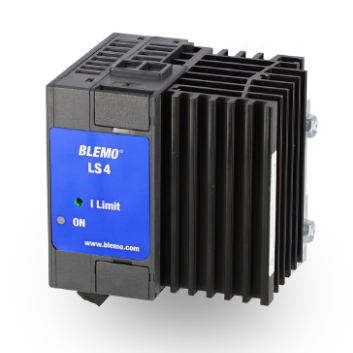
LS4
Easy integration and
commissioning at an attractive price;
16 to 50 A from 100 V to 500 V

LS14
Compact, maximum functionality
with simple operation and setup;
1 to 125 A from 100 to 500 V
Your personal contact person

Everything at a glance! Downloads for BLEMO products and other helpful downloads can be found here.
In general, they are used wherever, for example, electrical power needs to be precisely adjusted and usually converted into thermal energy. Examples include plastics processing and industrial furnace construction.
Power controllers are often used whenever the power consumption of an electrical device needs to be precisely controlled.
In addition to precise adjustment options for current control and current limitation, power controllers also offer functions for monitoring fuse failure, wire breakage, or load voltage failure, and for protecting electronic components.
In many cases, heating elements in particular are operated in parallel. Partial load failure monitoring is used here, which signals the failure of a heating element. When the system comes to a standstill, the affected heating element can be replaced.
The limitation of temperature-sensitive heating elements can also be defined, for example via a temperature-dependent resistance. The power controller acts as a kind of temperature limiter for the heating element and thus protects the heater from an excessively high operating temperature. The heating element has a maximum permissible temperature, which is limited by the power output from the power controller. This example shows the great advantage of power controllers in industrial and private use.
Power controllers can also be used as electronic components for limiting and controlling DC voltages. However, these differ from those used to control an AC voltage, as additional electronic components (e.g. a capacitor) are used in the process when operating with DC voltage. These power controllers are referred to as “direct current controllers”, among other things. In contrast to a classic rectifier or inverter, this type of component does not rectify the current.
Amplitude control:
Amplitude control is a method of controlling an electronic component by controlling the amplitude in alternating current technology. The amplitude of the sinusoidal current from the power grid is changed.
The process is similar to pulse width modulation, but in the classic case, square-wave pulses are used. The amplitude of the amplitude control only depends on the power drawn, so that the shape of the oscillation is not changed.
Current and voltage are in phase, which means that only the so-called “active power” is drawn during amplitude control. This significantly reduces the current consumption on the mains side compared to the current consumption with the phase angle control method. The advantage of this is that the continuous current flow leads to gentler operation, for example of the heating elements used, and therefore to a longer service life.
This control method reduces the surface load limits of heating elements, for example. Amplitude control can also be used to reduce the known effect of “flicker” (fluctuations in the power grid with the sometimes visual perception of flickering, e.g. in lamps) and harmonics. The specifications for this are described in the EN 61000-3-2 and EN 61000-3-3 standards.
Pulse packet control (pulse group operation):
Pulse packet control, also known as “pulse group operation”, is a subtype of pulse width modulation. As with pulse width modulation, pulse packet control avoids a longer on and off phase by selectively switching the individual full waves from the mains. As a result, each individual half-wave is cut.
This type of control is used to regulate the power of electrical consumers. Practical applications include instantaneous water heaters or electric heating systems.
In contrast to phase angle control, the signal is switched in the zero crossings in pulse packet control. As a result, this method avoids harmonics as far as possible.
Phase control
Phase control, or simply “phase control”, is also used to control power controllers for electrical devices and loads. The prerequisite is that these are operated with an AC voltage.
Examples of loads that can be operated with phase control are torque controllers for AC motors and dimmers. With this method, the current flow is controlled with an anti-parallel circuit of two thyristors. These have the task of switching the AC voltage. The load is switched between the zero crossings.
Everything from a single source:
From commissioning to maintenance and warranty extension to repairs